

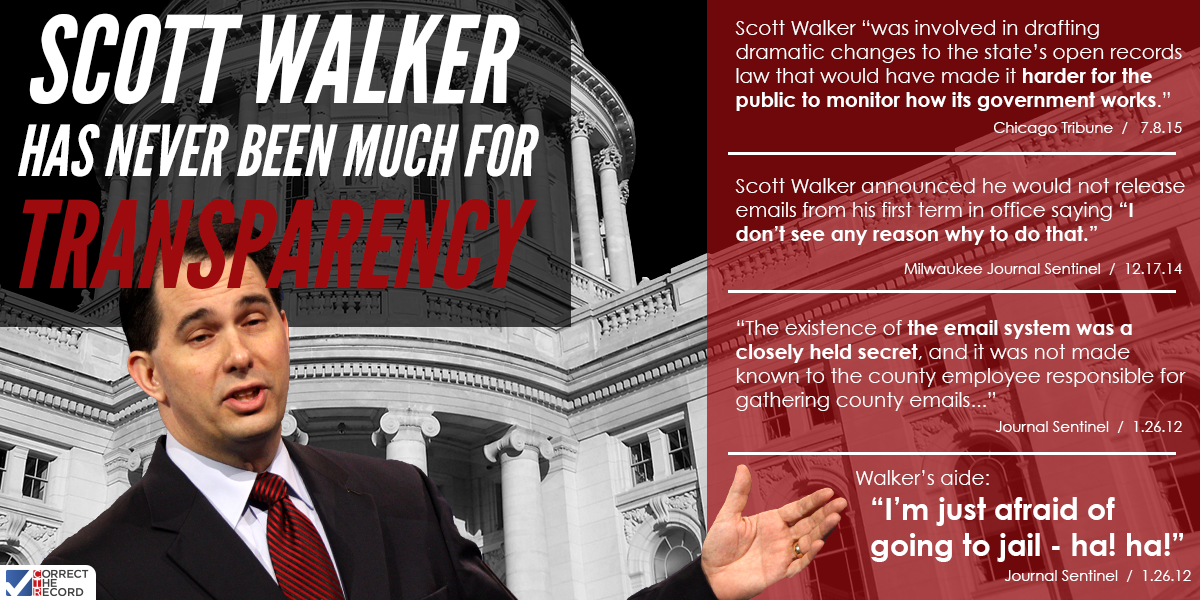
When was the last time a Republican official or presidential candidate was asked to meet the transparency standard Hillary Clinton meets on a daily basis? The Republicans running for president want to hold Hillary Clinton to an unprecedented double standard while refusing to answer even a single question about their shady transparency track records. This week, Scott Walker became the most recent candidate to join in on the hypocrisy, taking to Twitter to launch false charges regarding Clinton’s email.
Scott Walker is the last person who should dole out advice on transparency – not only was Walker a target in a criminal investigation into political corruption, he also helped draft a bill to make public records harder to access. Don’t forget, Walker’s office had a secret email system hidden from public record and his staffers were charged with illegal activity.
While Hillary Clinton continues to demonstrate unprecedented levels of transparency by pro-actively releasing her emails to the public, Scott Walker is proving the wisdom of those who have called him “more Nixonian than Nixon.”
Scott Walker
Open Records
The Nation: Scott Walker “has never been much for transparency.” “Wisconsin Governor Scott Walker is caught up in a hometown controversy that is going from bad to worse. The governor—whom former White House counsel John Dean refers to as ‘more Nixonian than Nixon’—has never been much for transparency. But a botched attempt by his legislative allies to gut the state’s open-records law has blown up on Walker in a big way.” [The Nation, 7/8/15]
Chicago Tribune: Scott Walker “was involved in drafting dramatic changes to the state’s open records law that would have made it harder for the public to monitor how its government works.” “Gov. Scott Walker’s office was involved in drafting dramatic changes to the state’s open records law that would have made it harder for the public to monitor how its government works, a spokeswoman confirmed Tuesday. Spokeswoman Laurel Patrick’s statement came after numerous inquiries from the State Journal in recent days and after Senate Majority Leader Scott Fitzgerald said Tuesday that Walker’s office collaborated with Assembly and Senate leaders to draft the changes.” [Chicago Tribune, 7/8/15]
Walker declined to say if he thought the legislature should be subject to open records or meeting laws. “Walker also declined to say whether the Legislature should abide by the open records law or be subject to the meetings law, including party caucuses. Instead, he responded that he retains ‘all public records, including email, for public inspection upon request.’” [Wisconsin State Journal, 10/1/14]
The John Doe investigation revealed that a Walker campaign staffer urged the Milwaukee county staff to drag out an open records request from the Democratic Party of Wisconsin. “Last November, the John Doe probe revealed that a Walker campaign staffer urged that Milwaukee County staff ‘drag out’ an open records request from the Democratic Party of Wisconsin. One Wisconsin Now has suggested this is part of an ongoing pattern.” [Green Bay Press-Gazette, 3/16/13]
E-mails
Scott Walker announced he would not release emails from his first term in office following Jeb Bush’s email release. “Gov. Scott Walker won’t follow Jeb Bush’s lead by voluntarily releasing all of his emails from his first term in statewide office. ‘I don’t see any reason why to do that,’ Walker said at a Milwaukee press event on Wednesday. Earlier this week, Bush said he would make public some 250,000 emails from his two terms as Florida’s governor and publish a new e-book in the ‘interest of transparency.’ Bush made the announcement a day before, saying he will ‘actively explore the possibility of running for president.’” [Milwaukee Journal Sentinel, 12/17/14]
Complaint: A ‘secret email system’ existed in County Executive’s office and was “routinely used by selected insiders within the Scott Walker administration” for county business as well as unofficial purposes such as campaigning. “The complaint reveals a ‘secret email system’ that was ‘routinely used by selected insiders within the Walker administration’ for county business as well as unofficial purposes such as campaigning.” [Journal Sentinel, 1/26/12]
- Investigators found boxes for two wireless routers in Scott Walker’s county executive office; packing labels with the boxes had deputy chief of staff Tim Russell’s name on them. “Investigators found boxes for two wireless routers in an armoire in Walker’s County Executive office. Packaging labels found with the boxes bore the name ‘Timothy Russell.’ The allegation is that Russell (who was Deputy Chief of Staff before becoming Housing Director) set up an unofficial networking system so that staffers could conduct campaign business on their personal laptops while their salary was being paid by the taxpayers. The secret email system was available for use by certain staff for both official and unofficial business.” [The Huffington Post, 1/30/12]
Investigators determined Darlene Wink and Kelley Rindfleisch were campaigning on county time
Two staffers in Scott Walker’s County Executive administration were charged with illegally doing extensive political work while being paid by taxpayers to do county jobs. “Two staffers who worked directly for Gov. Scott Walker while he was county executive were charged Thursday with illegally doing extensive political work while being paid by taxpayers to do county jobs. One of the two, Darlene Wink, cut a deal with prosecutors under which she agreed to provide information in a related investigation about the destruction of digital evidence and to aid in further prosecutions. This is the first indication that the multifaceted John Doe investigation may be pursuing charges of evidence tampering.” [Journal Sentinel, 1/26/12]
Criminal complaint: A Walker staffer told a friend shortly after taking the job with Walker that “half of what I’m doing is policy for the campaign.” “On Thursday, prosecutors charged Kelly Rindfleisch, deputy chief of staff to Walker in 2010, with four felony counts of misconduct in office for working for then-Rep. Brett Davis’ 2010 campaign for lieutenant governor while on the county clock. Davis, who lost in the Republican primary, is now Walker’s state Medicaid director. The complaint says that Rindfleisch told a friend in an Internet chat shortly after taking the job with Walker that ‘half of what I’m doing is policy for the campaign.’” [Journal Sentinel, 1/26/12]
A Walker staffer sent more 1,380 fundraising emails during work hours. “During work hours between February 2010 and early July 2010, it says, Rindfleisch sent more than 300 emails to Davis and 1,380 fundraising emails. The John Doe also turned up more than 1,000 emails between Rindfleisch and top staffers on Walker’s 2010 campaign during work hours over the same period.” [Journal Sentinel, 1/26/12]
While doing political work on taxpayer time, a Walker aide told a colleague: “I just am afraid of going to jail.” “Wink worked on campaign fundraisers, phone banks, Reagan Day dinners and Milwaukee County Republican Party matters while working in Walker’s office. In one 2009 chat with Timothy Russell, a longtime friend and fellow Walker aide, Wink asked how she could clear a document from her chat session. Russell told her it would disappear when she logged out. ‘I just am afraid of going to jail – ha! ha!’ Wink wrote in August 2009. Russell replied, ‘You wouldn’t, not for that.’” [Journal Sentinel, 1/26/12]
The John Doe investigation involved charges that aides in Scott Walker’s Milwaukee County Executive office were working to elect Brett Davis for lieutenant governor while collecting checks from the taxpayers. “When Rebecca Kleefisch ran for lieutenant governor in 2010, she actually beat Scott Walker’s favored candidate, Brett Davis, in the Republican primary. (Much of the current John Doe investigation involves charges that aides in Walker’s Milwaukee County executive office were working to elect Davis while collecting checks from the taxpayers.)” [Wisconsin State Journal, 5/27/12]
Public records laws were bypassed
The secret email system was hidden from public records officer. “The existence of the email system was a closely held secret, and it was not made known to the county employee responsible for gathering county emails in response to requests for information by the public, reporters and groups, the complaint said. The secret system used personal Internet email accounts.” [Journal Sentinel, 1/26/12]
The secret computer network was also used for official business, including records that should have been subject to public records laws. “Rindfleisch and Wink did campaign work on the unofficial network, the complaint says. The secret email system also was used for county business ‘which could have and which did include communications’ subject to the state’s open records statute, the complaint says.” [Journal Sentinel, 1/26/12]
An investigation found that Walker often comingled official and campaign business
Scott Walker and his top campaign and Milwaukee County aides were named as part of a team that routinely commingled political and official county business. “Gov. Scott Walker and his top campaign and Milwaukee County aides were named Monday as part of a team that routinely commingled political and official county business. The disclosures came during the sentencing of a former aide to Walker during his last year as Milwaukee County executive. Kelly M. Rindfleisch, 44, was sentenced by Milwaukee County Circuit Judge David Hansher to six months in jail and three years of probation on a single felony count of misconduct in office. The judge stayed the sentence pending Rindfleisch’s appeal to the Wisconsin Court of Appeals or the state Supreme Court. In a lengthy presentation during Rindfleisch’s sentencing, Assistant District Attorney Bruce Landgraf displayed numerous emails between Rindfleisch and key members of Walker’s campaign staff in which they discussed how to manage county government in 2010, while Walker was a candidate for governor. […] Landgraf said ‘The Campaign Group’ included Walker, Gilkes, campaign spokeswoman Jill Bader and campaign adviser R.J. Johnson. It also included several top county aides to Walker: Cindy Archer, who was county administration director; county chief of staff Tom Nardelli; spokeswoman Fran Mc-Laughlin; housing director Timothy Russell; and Rindfleisch.” [Milwaukee Journal Sentinel, 11/19/12]
- Prosecutor: The campaign group vetted news releases that were issued from Walker’s county office. “The Campaign Group vetted news releases that were issued from Walker’s county office, Landgraf said. They included messages about a federal disaster declaration the county was seeking after torrential rains in July 2010; news reports in the Journal Sentinel in August that year about patient sexual assaults at the county Mental Health Complex; and the acknowledgment by Darlene Wink, a county office assistant, of sending campaign related emails criticizing Barrett from Walker’s courthouse office.” [Milwaukee Journal Sentinel, 11/19/12]
- Prosecutor: E-mails showed that Scott Walker and his campaign directed county staffers to take official actions to boost walker’s candidacy. “Scott Walker and his gubernatorial campaign directed Milwaukee County staffers to take official actions in 2010 to boost Walker’s candidacy, including how to respond to a fatal incident at a county parking garage and requiring that press releases from the county executive’s office be reviewed by the campaign, according to emails released Tuesday. Assistant District Attorney Bruce Landgraf presented evidence in court Monday that former Milwaukee County staffer Kelly Rindfleisch traded 3,486 emails with top Walker campaign staffers, including 2,216 during regular work hours between January and October 2010. At the time, Rindfleisch earned $59,560 a year from Milwaukee County as Walker’s deputy chief of staff.” [Wisconsin State Journal, 11/21/12]
Jeb Bush
Foundation for Florida’s Future
Did Not Consistently Publish Donors
1995: The Foundation for Florida’s Future declined to release a list of its donors. “Bush says the foundation is supported by contributions, but he declines to provide a list of the donors. When asked why, he says: ‘Because I didn’t advise them of it. I don’t think it’s fair to people after the fact to go public. They are good private citizens, doing what they think is right,’ Bush said.” [St. Petersburg Times, 7/24/95]
1998: The Foundation for Florida’s Future released a list of its donors. According to the St. Petersburg Times, “Bush spokesman Cory Tilley dismissed the MacKay challenge as a non-issue. Though not legally required, the foundation’s annual report lists everyone who gave to the foundation, including the contribution range they fell within. All that’s missing is the exact amounts given by each contributor.” [St. Petersburg Times, 5/8/98]
2006: The Foundation for Florida’s Future vowed to publicly disclose its donors. “It’s unclear precisely what the foundation, a non-profit issue advocacy group, will spend the money on. But there will be one distinct difference between his revamped foundation and the version he ran after losing his first race for governor in 1994: This time donors will be fully disclosed.” [Tampa Bay Times, 2/7/06]
2007: The Foundation for Florida’s Future’s donors were “no longer publicly disclosed online.” According to the Miami Herald, “Friends and former staff guard Bush’s privacy as aggressively as they once touted his agenda. Donations to his educational think tank, the Foundation for Florida’s Future, are no longer publicly disclosed online. The group’s executive director declined to respond to e-mails and phone calls inquiring about the governor’s activities.” [Miami Herald, 4/15/07]
2011: The Foundation for Florida’s Future’s “does not disclose donors.” According to Florida Trend, “Foundation For Florida’s Future (Tallahassee) 2011 Revenue: $291,772 Key Personnel: Former Gov. Jeb Bush and Patricia Levesque. Bush is chairman, and Levesque, who served as Bush’s deputy chief of staff, is executive director. Funding Sources: The group does not disclose donors. ” [Florida Trend, 10/1/13]
2015: The Foundation for Florida’s Future only listed donations made between 2012 and 2014 until the Associated Press requested its full list. “Until recently, the Foundation for Excellence in Education revealed the names of its donors only from 2012 to 2014. In response to an Associated Press request seeking the full list dating to 2007, the foundation released nearly every donor during its existence, encompassing 428 contributions, with just one or two of the 187 donors still remaining anonymous.” [Associated Press, 7/1/15]
Foundation for Excellence in Education
FEE Allegedly Scrubbed its Website of Corporate Donors after Receiving Unfavorable Press
Sun-Sentinel’s Stephen Goldstein: The Foundation for Excellence in Education removed a list of its corporate donors “after embarrassing articles about how the foundations benefit contributors” were published. “After embarrassing articles about how the foundations benefit contributors, the names of corporate donors were scrubbed from the website of the Foundation for Excellence. The Foundation for Florida’s Future is so relentless that a couple of years ago, it pushed to amend the state Constitution so religious schools could receive taxpayer dollars. Fortunately, Florida voters nixed it. Both foundations should stop hiding behind their IRS charitable exemptions and reveal who their donors are, how much they contribute and how their lobbying may benefit them. If they really believe in quality education, they ought to prove it by telling the truth.” [Stephen Goldstein, Fort Lauderdale Sun-Sentinel, 6/9/13]
- The Foundation for Excellence in Education’s website listed its donors before the publication of these articles, removed the list immediately after their publication, and replaced it with an incomplete list months later. A review of the Foundation for Excellence in Education’s website through the Internet Archive shows that in August 2012, before the publication of “embarrassing articles about how the foundations benefit contributors,” a list of the foundations donors could be found on the website. As of February 2013, after the publication of the critical articles, the website no longer had any page with foundation donors. By June 2013, a very limited list of donors made up only of other foundations was listed on the website. [Wayback Machine, Foundation for Excellence in Education Meet The Donors Page, archived 8/15/12; Wayback Machine, Foundation for Excellence in Education, archived 2/25/13; Wayback Machine, Foundation for Excellence in Education Meet Our Donors Page, archived 6/4/13]
Received Nearly $1 Million in Anonymous Donations
2012-14: The Foundation for Excellence in Education received 14 anonymous donations worth up to almost $1 million. According to the Foundation for Excellence in Education, in 2012, the foundation received 9 anonymous donations worth between $205,003 and $550,000. In 2013, the foundation received 5 anonymous donations worth between $160,003 and $400,000. In total, from 2012 to 2014, the foundation received between $365,006 and $950,000 in 14 anonymous donations. [Foundation for Excellence in Education, Accessed 4/23/15]
Avoiding Lobbying Restrictions
The Foundation for Excellence in Education avoided restrictions on its lobbyists giving gifts to elected officials by registering them with Jeb Bush’s other foundation. “Among the activities of Bush’s Foundation for Excellence in Education that have come in for criticism: It pays for state officials and legislators to go to conferences where they meet with the company’s donors, including officials of corporations who stand to gain from the policymakers’ decisions. […] Normally, it’s illegal for lobbyists or lobbying organizations to provide benefits such as free trips to Florida legislators or top executive branch officials. But the Foundation for Excellence in Education escapes that prohibition because lobbyists on its staff are registered to another, closely related Bush foundation – even though the two share key staff members and even their Tallahassee address.” [Tampa Tribune, 3/3/13 (via archive.org)]
George Bush Presidential Library Foundation
Jeb Bush led the Foundation from 1996 to 1998, and remains on its Board of Directors
1996: Jeb Bush was President of the George Bush Presidential Library Foundation. “The Japanese government has given Texas A&M University a $ 1.5 million gift for its George Bush Presidential Library. Japanese Consul-General Shintaro Sasaki of Houston formally presented the gift Monday to Bush’s son, Jeb, president of the Bush Library Foundation.” [Houston Chronicle, 4/25/95]
1997: Jeb Bush was President of the George Bush Presidential Library Foundation. “Jeb Bush, another of the ex-president’s sons, is president of the George Bush Presidential Library Foundation that raised more than $ 40 million for the project.” [Houston Chronicle, 11/6/97]
1998: Jeb Bush was head of the George Bush Presidential Library Foundation. “Last fall, shortly before Jeb Bush kicked off his campaign, he appeared with his dad in College Station, Texas, when he emceed the opening of the Bush presidential library. Jeb heads the library foundation.” [St. Petersburg Times, 5/17/98]
2001: Jeb Bush was no longer listed as President of the George Bush Presidential Library Foundation. [George Bush Presidential Library Foundation official website, 3/7/01 (via archive.org)]
2015: Jeb Bush remained on the board of directors of the George Bush Presidential Library Foundation. [George Bush Presidential Library Foundation official website, accessed 5/18/15]
Disclosure of Donors
The George Bush Presidential Library Foundation’s “website provides no information regarding donors.” “The George Bush Presidential Library Foundation, which was set up in 1991 to fund the museum and library for former President George H.W. Bush at Texas A&M University, raises less than $3 million a year these days and, as of 2013, had $47 million in assets. Its website provides no information regarding donors, and Kristin King, the foundation’s director of communications, did not respond to repeated calls and emails requesting information about its donor disclosure policies. An internet search turned up no instances of this foundation releasing the names of its backers.” [Mother Jones, 4/30/15]
Foreign Donations
The George Bush Presidential Library received $6 million from foreign governments. “Texas A&M University is contributing $ 43 million, mostly from state funds, according to figures provided by the George Bush Presidential Library Foundation. The project also includes the George Bush School of Government and Public Service. Private fund raising by the presidential foundation has generated $ 34 million from 300 donors, said Don Wilson, executive director of the presidential library. […] Foreign contributions include $ 2 million each from the nations of Kuwait and the United Arab Emirates and $ 1 million each from the governments of Taiwan and Japan.” [Dallas Morning News, 5/6/96]
The George W. Bush Foundation
Disclosure of Donors
The George W. Bush Foundation “does not have a policy of full disclosure for its donors.” “The George W. Bush Foundation raised $361.8 million between 2010 and 2013, according to its latest tax filing. But it does not have a policy of full disclosure for its donors. According to Hannah Abney, the communications director for the George W. Bush Presidential Center, the names of the foundation’s major donors are etched into three ‘donor walls’ in the Dallas-based Bush Center at Southern Methodist University, and the ‘Freedom Registry,’ located at the entrance to the George W. Bush museum and library, lists donors who have contributed more than $20. No specific donation amounts are noted, and there’s a catch: Any donor who wishes to remain anonymous is not named. Moreover, the only way to see the list of nonanonymous donors is to visit the actual museum and look at the walls and the registry. The George W. Bush Foundation does not make its list available in any other form or in any other place.” [Mother Jones, 4/30/15]
Open Records
Jeb Bush “made it extremely difficult for anyone to get possession of a public record from his office, frequently stalling for months.” According to an op-ed by Lucy Morgan in the St. Petersburg Times, “Bush tangled with reporters from the minute he was elected, refusing at first to release copies of transition records. Once in office, Bush made it extremely difficult for anyone to get possession of a public record from his office, frequently stalling for months before even routine documents were produced. Crist’s staff routinely released transition records, including requests from people seeking jobs. Bush waited until inaugural events were long over before releasing a list of who made contributions to pay for them. Crist released the names of contributors as the checks came in, posting them on the transition Web site.” [Morgan, St. Petersburg Times, 1/5/07]
2006 St. Petersburg Times editorial: “Some state agencies during Gov. Jeb Bush’s tenure have not been as responsive as they should be” about making records public. “Gov.-elect Charlie Crist has demonstrated this week that his commitment to open government and well-run elections, two areas where Florida could stand some improvement, extends well beyond political rhetoric. His creation of the Office of Open Government and his appointment of Pasco Supervisor of Elections Kurt Browning as secretary of state are excellent steps toward reasserting the importance of two core values essential to democracy. Some state agencies during Gov. Jeb Bush’s tenure have not been as responsive as they should be about providing the public with records and basic information that should not be secret. Bush’s office has been known to keep close daily track of which reporters are requesting what information from which state agency, and at times the approach in Tallahassee has been to stall as long as possible and then release records grudgingly. The Legislature, meanwhile, has been busy carving out as many exemptions to the public records laws as possible.” [Editorial, St. Petersburg Times, 12/15/06]
2006 St. Petersburg Times editorial: Gov. Jeb Bush’s office “has been known to keep close daily track of which reporters are requesting what information from which state agency.” “Some state agencies during Gov. Jeb Bush’s tenure have not been as responsive as they should be about providing the public with records and basic information that should not be secret. Bush’s office has been known to keep close daily track of which reporters are requesting what information from which state agency, and at times the approach in Tallahassee has been to stall as long as possible and then release records grudgingly.” [Editorial, St. Petersburg Times, 12/15/06]
- 2006 St. Petersburg Times editorial: Bush’s administration would, at times, “stall as long as possible” in response to the requests “and then release records grudgingly.” “Some state agencies during Gov. Jeb Bush’s tenure have not been as responsive as they should be about providing the public with records and basic information that should not be secret. Bush’s office has been known to keep close daily track of which reporters are requesting what information from which state agency, and at times the approach in Tallahassee has been to stall as long as possible and then release records grudgingly.” [Editorial, St. Petersburg Times, 12/15/06]
St. Petersburg Times editorial: Gov. Jeb Bush’s office was “the only state agency that failed to comply” with the Florida public records law in a 2004 audit. “Four out of 10 government agencies failed to fully comply with the public records law in a recent audit conducted by 30 Florida newspapers, including the St. Petersburg Times. Those in charge of the documents used a variety of tactics to deny or delay the requests, by requiring that they be in writing, forcing the people asking for documents to identify themselves or, in one case, attempting to intimidate the person asking to see a record. […] Document caretakers frequently required the volunteers to identify themselves, state a purpose or make the request in writing (none of which is appropriate under the law). A few government officials attempted to intimidate those seeking a public record. Broward County administrator Roger Desjarlais threatened the person asking to see his office e-mails by saying, ‘I can make your life very difficult.’ Even Gov. Jeb Bush’s office – the only state agency that failed to comply with the law – required a form to be filled out before acceding to a public records request.” [Editorial, St. Petersburg Times, 2/10/04]
Gov. Jeb Bush met privately with top state officials to discuss tax cuts, Senate confirmations, and the state budget on his first full day in office, refusing to let reporters listen in. “On his first full day in office, Gov. Jeb Bush met with the two most powerful public officials in Florida’s Legislature, but the meetings weren’t public. Bush’s staff refused to let reporters in to listen as he chatted with House Speaker John Thrasher and Senate President Toni Jennings. The governor and his aides said the sessions were little more than ‘courtesy calls,’ but later they acknowledged they discussed tax cuts, Senate confirmation of appointments and the state’s multibillion-dollar budget. Florida’s Constitution requires meetings between the state’s top officials, where ‘pending legislation’ or ‘formal legislation’ is discussed, to be open.” [St. Petersburg Times, 1/7/99]
- The Florida Constitution requires that meetings between top state officials over “pending legislation” or “formal legislation” be open. “On his first full day in office, Gov. Jeb Bush met with the two most powerful public officials in Florida’s Legislature, but the meetings weren’t public. Bush’s staff refused to let reporters in to listen as he chatted with House Speaker John Thrasher and Senate President Toni Jennings. The governor and his aides said the sessions were little more than ‘courtesy calls,’ but later they acknowledged they discussed tax cuts, Senate confirmation of appointments and the state’s multibillion-dollar budget. Florida’s Constitution requires meetings between the state’s top officials, where ‘pending legislation’ or ‘formal legislation’ is discussed, to be open.” [St. Petersburg Times, 1/7/99]
- Bush initially said that the meetings were “courtesy calls,” only later admitting that government business was discussed. “On his first full day in office, Gov. Jeb Bush met with the two most powerful public officials in Florida’s Legislature, but the meetings weren’t public. Bush’s staff refused to let reporters in to listen as he chatted with House Speaker John Thrasher and Senate President Toni Jennings. The governor and his aides said the sessions were little more than ‘courtesy calls,’ but later they acknowledged they discussed tax cuts, Senate confirmation of appointments and the state’s multibillion-dollar budget. Florida’s Constitution requires meetings between the state’s top officials, where ‘pending legislation’ or ‘formal legislation’ is discussed, to be open.” [St. Petersburg Times, 1/7/99]
Jeb Bush met privately with top legislative leaders and representatives of a “significant business” the night before the Florida Legislature opened its 2006 session. “The night before the Florida Legislature opened its 2006 session, Gov. Jeb Bush met privately with top legislative leaders and representatives of a ‘significant business’ that is considering moving to the state, the Governor’s Office acknowledged Tuesday.” [Orlando Sentinel, 3/8/06]
- Jeb Bush’s spokesman refused to discuss the meeting, “citing provisions that exempt economic-development talks from the state’s public-records law.” “Also at the dinner were Lt. Gov. Toni Jennings; Senate President-designate Ken Pruitt, R-Port St. Lucie; House Majority Leader Andy Gardiner, R-Orlando; and House Budget Chairman Joe Negron, R-Stuart, Schweiss said. Schweiss would not provide any details about the meeting or the business, citing provisions that exempt economic-development talks from the state’s public-records law.” [Orlando Sentinel, 3/8/06]
- Jeb Bush’s spokesman insisted that Bush’s meeting with legislators and business representatives did not involve “any legislation.” “Florida’s Constitution requires that any meeting between the governor, Senate president and House speaker — or between three or more legislators — that concerns pending legislative action be open to the public. But Schweiss insisted the discussions did not involve any imminent action by the Legislature. ‘This isn’t something that would require any legislation,’ Schweiss said. ‘This is a business that wanted to meet with legislative leaders also.’” [Orlando Sentinel, 3/8/06]
Gubernatorial Transition
After winning the gubernatorial election, Jeb Bush claimed that his transition materials were not subject to public records laws because he was still a private citizen. “Bush, who had never held elected office until he was sworn in Tuesday, must get used to working under a microscope. Gone are the campaign days, when he could strategize with his political team and orchestrate events for the cameras. He tussled with some reporters soon after winning the election, claiming that his transition work was not subject to public records laws because he was still a private citizen. At the time, he promised things would be different once he took office, saying he intends to be more open than past governors.” [St. Petersburg Times, 1/7/99]
Schedules and Travel
Jeb Bush “refused to produce copies of his daily calendar – a public record under Florida law.” According to an op-ed by Lucy Morgan in the St. Petersburg Times, “The contrast couldn’t be more striking. On his first full day in office, Gov. Charlie Crist invited reporters into his private office and signed his very first executive order creating an Office of Open Government. Eight years ago on his very first full day in office, Gov. Jeb Bush refused to produce copies of his daily calendar – a public record under Florida law. When pressed, his staff released a calendar that said ‘office hours,’ omitting the customary names of those who might be on the schedule to meet with the governor.” [Morgan, St. Petersburg Times, 1/5/07]
Marco Rubio
E-Mails
Marco Rubio used a personal email account to “vent” about Republicans to reporters. “As Marco Rubio’s time as House speaker dwindles, he finds himself double teamed by the Senate and Gov. Charlie Crist. Over the weekend, he decided to vent. After the House devolved into partisan chaos over a decision by Rubio’s team to block Democratic debate on an education bill, Rubio dashed off a series of e mails to St. Petersburg Times reporters on his personal e mail account. He freely offered opinions, laying out each chamber’s top priorities, deriding the governor’s last minute plan to cut gas taxes and criticizing a tax commission’s hesitance to cap government tax revenues.” [St. Petersburg Times, 4/23/08]
- A Rubio spokesperson claimed the emails were deleted after media outlets requested copies. “Public or private? After House Speaker Marco Rubio’s remarks appeared Wednesday on the St. Petersburg Times’ Web site, tampabay.com, the Orlando Sentinel requested copies of Rubio’s e mails. House spokeswoman Jill Chamberlin said Rubio had deleted them from his personal account.” [St. Petersburg Times, 4/24/08]
- St. Petersburg Times: “The Times has encountered a similar response several times over the past year when asking for e-mails from Rubio’s personal account.” “The Times has encountered a similar response several times over the past year when asking for e mails from Rubio’s personal account. The Sentinel quoted the First Amendment Foundation’s Barbara Petersen, a public records expert, as saying that e mails relating to public business are public records, regardless of whether they were sent from a personal e mail account.” [St. Petersburg Times, 4/24/08]
Chris Christie
Open Records
Chris Christie’s administration paid upwards of $441,000 in legal fees fighting open records requests. “When a judge determines that the state withheld records illegally—which happens frequently—her group wins legal fees. As of September 2014, Christie’s administration had paid $441,000 to North Jersey Media Group and other media outlets for records. And that doesn’t count the cost of government lawyers’ time.” [Mother Jones, 2/4/15]
Chris Christie’s administration “waged costly court battles” rather than release records relating to the Bridgegate scandal. “On his first day as governor of New Jersey, Republican Chris Christie promised ‘a new era of accountability and transparency.’ But five years later, local reporters and watchdog groups accuse Christie’s administration of making unprecedented efforts to keep public records a secret. Stonewalled by the Christie administration, media outlets have been forced to sue to obtain even routinely disclosed information, such as payroll data. Rather than release documents connected to the George Washington Bridge scandal, pay-to-play allegations, possible ethics violations, and the out-of-state jaunts Christie has made while weighing a run for president, Christie’s office and several state agencies have waged costly court battles.” [Mother Jones, 2/4/15]
Chris Christie’s administration fought more than 23 open-records requests in court simultaneously. “As the 2016 presidential primary race draws closer, and Christie considers jumping in, his administration is fighting 23 different open-records requests in court.” [Mother Jones, 2/4/15]
Chris Christie’s open records stonewalling was possibly “the biggest public-records bottleneck since the state’s Open Public Records Act became law in 2002.” “The accumulation of cases may be the biggest public-records bottleneck since the state’s Open Public Records Act became law in 2002. State officials have declined requests from the media, members of the public and government watchdogs for a variety of reasons, including the threat of terrorism, overly vague language and the need to shield the governor from unnecessary breaches of his privacy.” [Record, 8/12/14]
Schedules and Travel
Chris Christie faced two lawsuits for records regarding his out of state travel. “Last year, New Jersey Watchdog, a conservative news site, demanded to know who picked up the tab for more than 60 unofficial trips Christie took out of state beginning in 2012. Christie’s office denied its request, and a judge tossed Watchdog’s resulting lawsuit in July for being too broad. In a separate request, New Jersey Watchdog asked for records detailing Christie’s out-of-state air travel expenses. That request also went to court, and the judge ordered the governor’s office to release some travel documents. The records showed the state reimbursing an unknown third party thousands of dollars for Christie’s trip to the 2013 Super Bowl in New Orleans.” [Mother Jones, 2/4/15]
- Two media organizations sued Chris Christie for records indicating whether taxpayers paid his travel costs to out-of-state Republican fundraisers. “Because Christie’s travel is connected to his fundraising work as the Republican Governors Association chair, the RGA probably paid for many of his trips. But the Record, one of Jersey’s largest newspapers, and WNYC, a radio station, requested documents indicating whether taxpayers shouldered any of Christie’s travel costs—such as overtime for the security detail that always accompanies the governor—while he raised cash for the GOP. Christie’s office sent WNYC ‘a document so heavily redacted as to be all but meaningless,’ says Laura Walker, the president of New York Public Radio, which owns WNYC. The outlet is suing for unredacted files. The Record also went to court for the documents, and the state and the newspaper are trying to reach a settlement.” [Mother Jones, 2/4/15]
Budgets and Taxes
Chris Christie’s administration removed property tax information from a state website after media reported that average property taxes had increased during his tenure. “The state Assembly will vote Monday on a bill from Democrats requiring the Division of Local Government Services in the Department of Community Affairs to post on its Internet web page a full summary of property tax data for each calendar year. The information already is collected by the DCA and it had been posted. But in the spring, when the Asbury Park Press and other media organizations reported on the growth of net property taxes during the Christie years, the department deleted the average homestead rebate and average net property taxes columns from the tax tables for 2008 through 2012. The Republican governor has championed caps on tax increases, which helped stabilize raw property tax bills, but relief programs have been weakened, thus adding to statewide tax average hikes.” [Asbury Park Press, 9/28/14]
- Times of Trenton editorial: Chris Christie’s administration took down property tax information from a state website “to discourage reporters” from comparing Christie’s record to his predecessors. “The Senate Budget and Appropriations Committee advanced a bill this week that would require the Christie administration to restore the missing stats: namely, town-by-town average residential property tax bills, the municipality’s average homestead credit payment, and the net average property tax bill after the credit is applied. The bipartisan committee approved the measure by a vote of 9-1, with three abstentions. A similar measure passed the Assembly in September by a vote of 73-0. But why did the information vanish in the first place? Anyone with an ounce of brains has to conclude that the move was orchestrated to discourage reporters (and other savvy citizens) from comparing the increase in average net property taxes – that is, property taxes minus rebates – under Gov. Chris Christie and his predecessor.” [Editorial – Times of Trenton, 12/11/14]
Chris Christie’s administration stopped releasing monthly comparisons between actual and forecast revenue after two Wall Street agencies lowered New Jersey’s credit rating. “The administration this month also tightened information coming out of the Treasury Department, which stopped releasing monthly cash comparisons between how much the state has raised and how much the administration had forecast. The reporting change came after two Wall Street agencies lowered the state’s credit rating and flagged inaccurate revenue forecasts.” [Asbury Park Press, 9/28/14]
Transparency Ratings
The Chris Christie administration was given a “C+” government transparency grade by New Jersey PIRG in 2014. “The administration of Gov. Chris Christie and the state Legislature received a grade of C+ today for their ‘middling effort’ to improve public disclosure of the spending of taxpayer dollars, particularly for its large economic incentive programs. The annual assessment, prepared by the New Jersey Public Interest Research Group, said the state was 30th in the nation in terms of spending transparency, worse than New York (13th) and Pennsylvania (24th), but better than Delaware (40th). ‘The governor should set his sights high and make New Jersey a leader in open government,’ said Jennifer Kim, the advocacy group’s state director. ‘With all the controversy that New Jersey has seen recently, we should be shooting for an ‘A’.’” [Star-Ledger, 4/8/14]
The U.S. Public Interest Research Group downgraded New Jersey’s transparency rating under Chris Christie to a “C.” “Many states across the nation are improving government spending transparency at a faster rate than New Jersey and the Christie administration should do more to keep pace, according to a new report issued today by the U.S. Public Interest Research Group. The organization evaluated 48 states with transparency websites and assigned New Jersey the grade of ‘C’, down from a ‘C+’. Top grades went to Texas, Massachusetts, Florida, Illinois, Kentucky, Michigan and Oklahoma. ‘New Jersey’s falling score does not mean spending has become less transparent,’ said Jen Kim, state director of NJPIRG, state in a statement. ‘It means other states are improving faster.’” [Star-Ledger, 3/26/13]
E-mails
Chris Christie administration emails and texts released during the Bridgegate investigation “revealed…that state officials use personal e-mail accounts and cell phones to communicate.” “The thousands of e-mails and texts released as part of the investigation into the September lane closures on the bridge revealed what many open public records advocates have long suspected: that state officials use personal e-mail accounts and cell phones to communicate.” [Star-Ledger, 1/13/14]
The ACLU called on Chris Christie to require all state employees to use state email for business. “The American Civil Liberties Union of New Jersey today called on Gov. Chris Christie and the state attorney general to require all public employees to use government e-mail accounts and cell phones to conduct official business, in response to the unfolding George Washington Bridge lane-closure scandal. The group said in a letter that the release of thousands of pages of e-mails and text message Friday related to the scandal showed government employees are attempting to circumvent the state Open Public Records Act by using personal accounts to discuss official matters.”[Star-Ledger, 1/13/14]
The ACLU believed that Christie administration officials “could be attempting to circumvent the state open public records act by using personal accounts to discuss business.” “In a letter to Gov. Chris Christie, the state attorney general and several state lawmakers, the ACLU said the communications showed employees could be attempting to circumvent the state Open Public Records Act by using personal accounts to discuss business.” [Star-Ledger, 1/13/14]
Regina Egea Deleted Text Messages Between Her And Christie
A legislative report showed that there were 12 text messages exchanged between Chris Christie and Regina Egea on day the Port Authority started to question the Christie administration’s explanation for lane closures. “Contradicting sworn testimony and New Jersey Governor Chris Christie’s repeated accounts that he barely paid attention last fall to the burgeoning scandal surrounding politically-motivated lane closures on the George Washington Bridge, a new report shows there were 12 text messages exchanged between the Governor and a top aide during an explosive day of testimony a year ago. That was the day that top officials of the Port Authority of New York and New Jersey began to dismantle key elements of the Christie administration’s official explanation of events — that the lane closures were a traffic study gone awry. AT&T did not release the content of the texts, and it’s not unusual that the Governor and the aide would have been exchanging messages that day with the aide, Regina Egea, his incoming chief of staff and head of his authorities unit, who was monitoring the testimony. But their previous denials raises the question of what other communications were deleted as the scandal unfolded.” [WNYC, 12/5/14]
- Egea said the texts were not substantive and that she did not know when she deleted the texts. “In Egea’s own testimony last summer, the new report notes, she referred to a single text she sent that day as ‘not at all substantive.’ She said she ‘couldn’t recall’ a response from the governor. Egea acknowledged deleting the text, though she couldn’t say when.” [WNYC, 12/5/14]
- Christie told friends he texts instead of emails because text messages are harder to trace. “The governor has told allies that he had learned when he was the United States attorney for New Jersey to communicate by text rather than email, because text messages are harder to trace. (Email can remain on servers even after being deleted; cellphone carriers vary in how long they preserve deleted texts.)” [New York Times, 8/27/14]
- Regina Egea testified that she deleted text messages between her and Christie about the lane closings. “Gov. Chris Christie’s designated future chief of staff, Regina Egea, testified that she texted the governor about the lane closings in December, after testimony in a hearing that day disputed his administration’s assertion that the closings were part of a traffic study. But she said she deleted the texts.” [New York Times, 7/17/14]
Rick Perry
Open Records
Rick Perry “withheld information in response to some 100 open-records requests.” “Over the past decade, the Perry administration has withheld information in response to some 100 open-records requests, instead seeking review by the Texas Attorney General’s Office.” [Houston Chronicle, 8/28/11]
Rick Perry “adopted policies that shroud his own office in a purposeful opaqueness that confounds prying reporters – or any member of the public questioning his policies.” “Now, as Gov. Rick Perry embarks on a presidential campaign, it is unlikely the public will access records that provide many revealing details about his decade-long tenure as governor. While Perry extols open government – most recently challenging Federal Reserve Chairman Ben Bernanke to ‘open the books’ of the nation’s central bank – he has adopted policies that shroud his own office in a purposeful opaqueness that confounds prying reporters – or any member of the public questioning his policies.” [Houston Chronicle, 8/28/11]
Rick Perry’s administration “acknowledged it failed to meet legal deadlines for responding to the requests, or otherwise delayed in violation of well-established procedures outlined in the Texas Public Information Act.” “In two cases in the past year, Perry’s office acknowledged it failed to meet legal deadlines for responding to the requests, or otherwise delayed in violation of well-established procedures outlined in the Texas Public Information Act. Most of the withheld documents involved contracts, bidding and oversight of programs in which state money flows to entrepreneurs, privately held companies and universities from Perry’s two economic development funds, the Emerging Technology Fund and the Texas Enterprise Fund. In some cases, the requests involve entities headed by Perry campaign donors and political appointees. Perry also chose to withhold information when third parties complained they would release proprietary information or violate trade secrets.” [Houston Chronicle, 8/28/11]
Executions
Rick Perry refused to release information relating to a clemency request by a man executed for capital murder. “The Houston Chronicle has a lawsuit pending regarding Perry’s decision on a clemency request in 2004 by Cameron Todd Willingham, whose capital murder conviction stirred debate over the science of arson investigations. Perry refused the newspaper’s request to release his staff’s analysis or comments about Willingham’s request for clemency, which raised new evidence. Willingham was executed Feb. 17, 2004.” [Houston Chronicle, 8/28/11]
State Contracts
Rick Perry’s administration withheld documents involving “contracts, bidding and oversight of programs in which state money flows to entrepreneurs, privately held companies and universities.” “Most of the withheld documents involved contracts, bidding and oversight of programs in which state money flows to entrepreneurs, privately held companies and universities from Perry’s two economic development funds, the Emerging Technology Fund and the Texas Enterprise Fund. In some cases, the requests involve entities headed by Perry campaign donors and political appointees. Perry also chose to withhold information when third parties complained they would release proprietary information or violate trade secrets. Among the information withheld from public view were communications between Amazon and the governor and his staff concerning the company’s recent dispute with the state of Texas over a $269 million sales tax bill. He has declined to release staff notes and emails relating to the Emerging Technology Fund and records relating to appointments to the advisory committee that oversees its grant applications. He also withheld emails and telephone logs relating to a $4.5 million Emerging Technology Fund grant awarded to Convergen Life Sciences, a company owned by campaign contributor David G. Nance.” [Houston Chronicle, 8/28/11]
Schedules and Travel
Rick Perry barred “the public from viewing details of his travel, his daily schedule and most of his emails.” “He has been governor longer than anyone in Texas history, but there is a lot the public does not know about Rick Perry. Where does he go each day, and with whom does he talk? What is discussed when he meets with top state agency executives? How does he evaluate a clemency request from a death row inmate? Or an application for a grant from his Emerging Technology Fund? What opinions are expressed to him through email and how does he respond? […] Those are just some of the questions left largely unanswered by Perry’s decisions to bar the public from viewing details of his travel, his daily schedule and most of his emails.” [Houston Chronicle, 8/28/11]
Rick Perry “leaned on lawmakers to include language in a school finance bill passed in the Legislature’s special session that would keep secret for 18 months the travel vouchers of his security team.” “Perry leaned on lawmakers to include language in a school finance bill passed in the Legislature’s special session that would keep secret for 18 months the travel vouchers of his security team. Until then, the public would be able to view only summary reports that disclose a trip’s destination, but not specific businesses visited or the names of family members accompanying the governor.” [Houston Chronicle, 8/28/11]
Rick Perry “fought for years to keep even mundane details of his schedule, spending and decision-making away from reporters and the public.” “Gov. Rick Perry’s straight talk may have made him an instant star of the Republican presidential field, but even some of his supporters say his frank one-liners don’t reflect his governing style in Texas, where Perry has been criticized as one of the most secretive governors in the country. At home, Perry has fought for years to keep even mundane details of his schedule, spending and decision-making away from reporters and the public. He faces pending lawsuits over his office’s refusal to release travel records and a clemency review for a since-executed inmate. He’s under pressure from open government advocates to release his full schedule. And in response to a once-lonely quest by a Wisconsin blogger, Perry’s office has temporarily stopped its practice of deleting emails after a week.” [Politico, 9/15/11]
Campaign Finance
Rick Perry “vetoed a ‘dark money’ bill that would have required greater campaign finance disclosure.” “It’s true that before he was governor, the state didn’t put much spending data online, but that’s partly because he became governor in 2000, well before most Americans had computers in their pockets. And in pursuing financial transparency, Perry has seemingly been more concerned about efficiency than ethics. When he has touted transparency as an ethical imperative, it has seemed political, as in 2009, when he issued an executive order commanding strict accounting standards for the federal funds that Texas was due to receive under the American Recovery and Reinvestment Act. And then, at times, he has set transparency aside altogether, as last year, when he vetoed a ‘dark money’ bill that would have required greater campaign finance disclosure.” [Texas Monthly, July 2014]
Rick Perry settled an ethics complaint “that accused his campaign of hiding how hundreds of thousands of dollars in campaign contributions were spent.” “And late last week, his team quietly finalized the settlement of an ethics complaint that accused his campaign of hiding how hundreds of thousands of dollars in campaign contributions were spent at his taxpayer-funded mansion on flowers, food, drinks and party supplies.” [Politico, 9/15/11]
Mike Huckabee
Destroyed Government Hard Drives
Mike Huckabee “destroyed government-owned hard drives as he left office,” and was accused of violating state law. “A lawsuit was filed Thursday against former Gov. Mike Huckabee that accuses the Republican presidential hopeful of breaking state law when his administration destroyed government-owned hard drives as he left office in January. Jim Parsons of Bella Vista filed the lawsuit in Pulaski County Circuit Court accusing Huckabee of violating the state’s Freedom of Information Act and a state law prohibiting damaging a computer without authorization.” [Associated Press, 7/27/07]
- A lawsuit against Mike Huckabee asked the court to “send a message that destroying public records is not the standard operating procedure.” “The state’s Ethics Commission has previously dismissed two complaints that Parsons, a self-described ‘gadfly,’ has filed against Huckabee over the hard drives’ destruction. The lawsuit, described in the filing as a ‘citizen complaint,’ asks the court to ‘send a message that destroying public records is not the standard operating procedure’ of elected officials when they leave office.” [Associated Press, 7/27/07]